Maximizing DevOps efficiency with GitOps on KakaoCloud

Hello! In this post, we introduce how to improve development and operations environments through GitOps on KakaoCloud.
GitOps, based on DevOps principles, refers to the process of using a Git repository as a single source of truth to track all changes and declaratively manage infrastructure, thereby maintaining consistency between infrastructure and applications. As a way to automate deployment and management of infrastructure and applications and maximize efficiency, GitOps has become one of the key methods for responding to rapidly changing market requirements as cloud-native environments spread.
In actual development environments, GitOps means managing infrastructure and application deployment using a Git repository as a single source of truth. Infrastructure is defined declaratively, all changes are tracked through Git, and deployments are automated. This series of tasks ensures that code stored in Git stays synchronized with the actual state of infrastructure and applications.
Why implement GitOps?
In practice, GitOps provides a wide range of benefits in modern software development and operations. First, declarative infrastructure lets you define the desired state of infrastructure as code. For example, if the configuration of a specific server is written as code, that configuration can be applied consistently at any time, maintaining consistency in infrastructure management. Through the version control principle of storing all configuration files in Git to track changes and manage versions, you can easily understand change history and roll back to a previous state when an issue occurs. Automated deployment applies changes to infrastructure automatically after code changes are approved, and because changes are tested and deployed through CI/CD pipelines, infrastructure management becomes more efficient.
Through these processes, GitOps greatly improves stability and reliability because infrastructure and applications defined as code can be deployed predictably and consistently. It can minimize human error, and changes are quickly tested and deployed through CI/CD pipelines, providing a fast feedback loop that enables issues to be resolved quickly. In terms of reducing operational costs, automated deployment and management reduce manual work and allow developers to focus on writing actual code, maximizing efficiency.
Resources required to implement GitOps
Several important resources are needed to implement GitOps.
- Git repository: A Git repository is needed to store all infrastructure code and manage versions. Common examples include the widely used GitHub, GitLab, and AWS CodeCommit.
- GitOps deployment tool: A deployment tool is needed to automatically deploy changes and continuously synchronize infrastructure and application states. Examples include ArgoCD, Flux, Jenkins X, and GitHub Actions.
- Kubernetes: GitOps is mainly used with container orchestration platforms such as Kubernetes. Therefore, a Kubernetes environment must be prepared in advance.
- Container Registry: A secure registry is needed to store and deploy container images.
Implementing GitOps on KakaoCloud
KakaoCloud provides cost-effective cloud infrastructure so customers can use cloud resources in an economically efficient way. KakaoCloud managed services reduce operational costs through automated features and help minimize unnecessary costs through flexible pay-as-you-go pricing.
You can use the following resources to implement a GitOps environment on KakaoCloud.
-
Kubernetes Engine: KakaoCloud provides Kubernetes Engine, a managed Kubernetes service, to make it easy to deploy and manage Kubernetes clusters. It ensures high availability and scalability, reducing the burden of infrastructure operations and letting you focus on development. Based on the benefits provided by Kubernetes Engine, you can build a GitOps environment and declaratively manage Kubernetes resources, maintaining change consistency and maximizing operational efficiency through automated deployment.
-
Container Registry: KakaoCloud provides a secure and reliable Container Registry service that lets you store, manage, and deploy container images. Container Registry integrates smoothly with CI/CD pipelines, enabling automated build, test, and deployment.
Usage example for implementing a GitOps environment
As a simple example, let's describe how a fictional Company A can build GitOps on KakaoCloud. Company A uses GitHub to version-control all infrastructure configuration and application code, and has built a CI/CD pipeline with GitHub Actions.
Company A's GitOps implementation process
Step 1. Code commit and automatic build
- Company A's development team commits code to GitHub whenever adding a new feature or fixing a bug.
- GitHub Actions is triggered to automatically build and test the code.
- When the build succeeds, a container image is created and pushed to KakaoCloud Container Registry.
Step 2. Automatic deployment and infrastructure specification update
- The infrastructure specification repository is updated by using a pipeline tool or directly.
- When the infrastructure specification repository is updated, ArgoCD, the GitOps tool, detects it.
- ArgoCD checks the updated specifications and automatically deploys changes to the Kubernetes cluster.
Step 3. Environment reflection
- When the specifications for the development environment are updated, deployment proceeds to the development environment.
- When the specifications for the production environment are updated, deployment proceeds to the production environment.
Through this series of processes, Company A was able to manage development and operations processes efficiently, significantly shorten deployment time, and reduce operational costs. You can check the detailed method for implementing this example on KakaoCloud.
Tutorial for configuring a GitOps environment
You can find the example GitOps environment configuration described above in detail in a tutorial in KakaoCloud technical documentation. The Build GitOps in a KakaoCloud Kubernetes environment tutorial explains how to set up a GitOps pipeline using the managed Kubernetes service Kubernetes Engine and Container Registry.
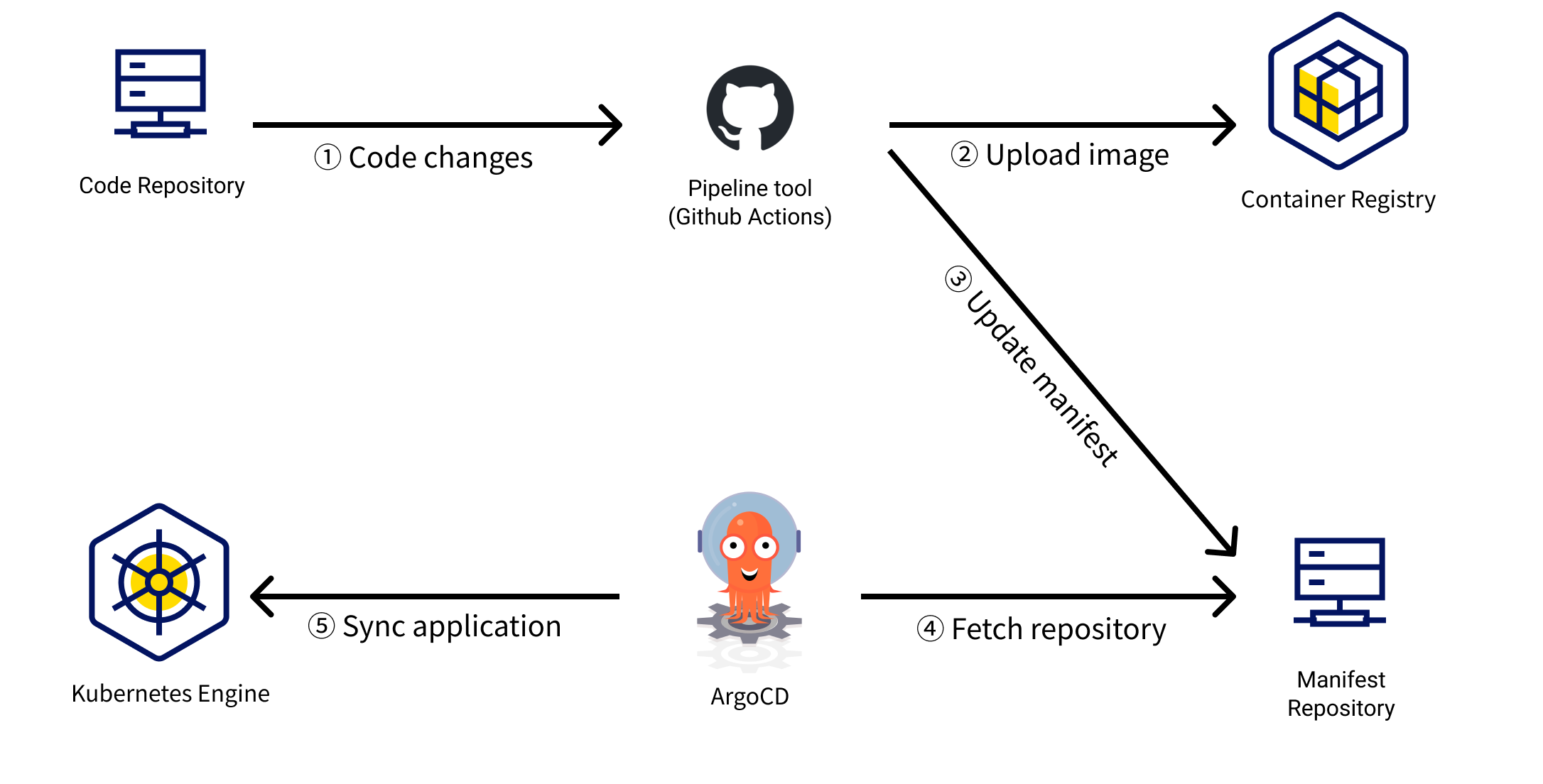 Tutorial architecture
Closing
As described above, GitOps is a powerful approach that can significantly improve development and operations processes by automating infrastructure and application deployment and management. Of course, introducing GitOps can involve initial setup and a learning curve. Sufficient planning and preparation are required, and it can take time until all team members become familiar with the new workflow. Therefore, it is recommended to introduce GitOps according to your situation and optimize the necessary tools and processes.
Please remember that, as shown in the GitOps pipeline tutorial, you can build a better development and operations environment with automated processes and consistent deployment management by using KakaoCloud services. We hope you experience improved productivity and cost savings directly.